

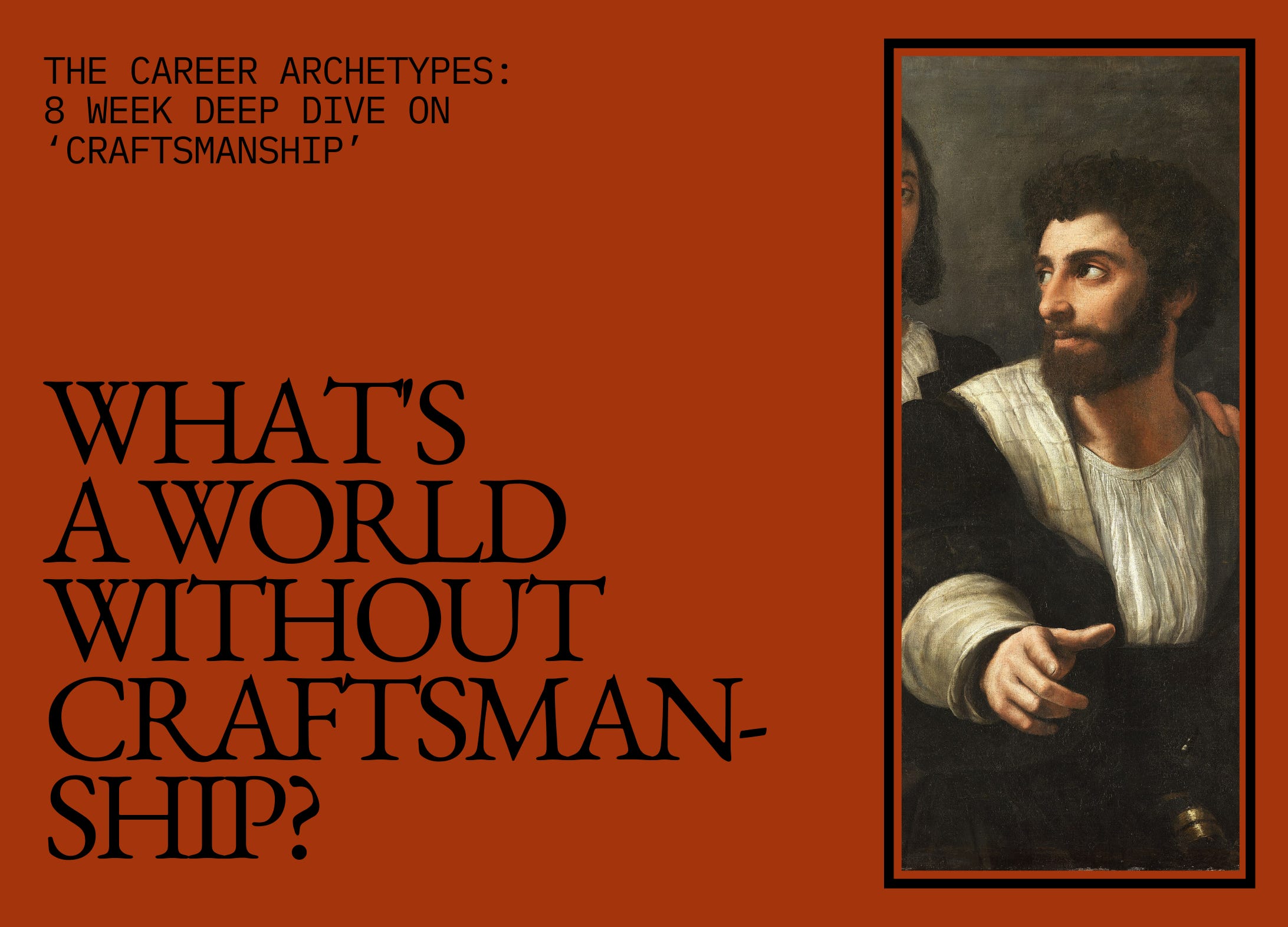
What's a world without craftsmanship?
Comparing a world of craftsmanship to one built on profit and shoddy work

It is a curse to yearn for the beautiful whilst having to stare at the works
that this modern world produces.
Fragile homes being built to last as long as a renters term, jackets threaded with weaves so distant that they fall apart after three washes, and books written for trends, algorithms and political agendas. Everyday items have been deteriorating over the past decade with the decline of craftsmanship and we are all suffering because of this. But the stock prices? They only rise. Happy to use quality and craftsmanship as an image which is no longer present in the backbone of the creation itself. This myth making process, discussed at length in boardrooms and during marketing team zoom calls, is all about the story of quality, either forgetting or not caring that it is not there.
One cannot help but recall René Magritte’s famous surrealist painting, “Ceci n’est pas une pipe”. This artwork shows a pipe with a sentence underneath that translates as, “This is not a pipe.” In the same way Magritte shows that the image is not the thing, we can point to modern homes, education, clothing, software, furniture, experiences, technology, food, and say, “This is not quality.” Nor is it beautiful, as beauty is a consequence of quality. The ancient Greeks understood this. In their time beauty was a marker of a society moving in the correct direction. Which is why when we look at our world we have to ask ourselves, why are we heading this way? If the answer is profit, then the reasoning is weak as society is poorer, not richer, because of it. For us to restore our damaged world, to make it lush, alive and ready to withstand the conditions of life, we must believe in craftsmanship again.

What does a world without craftsmanship look like? Well, we are already witnessing some of its consequences today. From a personal point of view it’s opening a fast delivery package to the synthetic smells of a far-away factory. From a global viewpoint it’s an increase in pollution and economic disparity. 85% of all textiles go to the dumps each year according to earth.org, and according to the economic policy institute between 1979 and 2024 productivity increased by 80.9% and hourly pay only grew by 29.4%. This means more waste and more poorly crafted items are being produced more efficiently, whilst everyday people have less buying power. But it gets worse.
If we continue agreeing to a world without craftsmanship, there will be no heirlooms to hand down because a grandmother’s ring will not be able to withstand the test of time. There will be a normalisation of purchasing multiple storage units to throw mindless purchases into. Couples that want to start families will be forced to save hundreds of thousands of dollars for a minimum deposit on a home that may not last the time it takes to pay the mortgage off. Then living on a street where all the homes on their street have the same paper thin walls, cheap flooring and fridges that manufacturers have designed to break just after the warranty. As Aldous Huxley writes in his novel The Island, “Armaments, universal debt, and planned obsolescence—those are the three pillars of Western prosperity.”
If we continue to agree to a world without craftsmanship we will plummet into a state of hopelessness. As there would be no inspiration, no human smudge, pressed into what one wears, what one reads, what one sits on or what one looks at. The signs are all around us. Short shelf-lives, details missed, cost cutting materials, items without character, these do not build a strong future. They build a weak one.
What does a world without craftsmanship look like?
The threads of a society coming undone.

How does craftsmanship address these issues? Well we can begin with it valuing longevity and durability. It’s not incentivised by replacement, rather it prides itself on enduring across extended periods of time. We see this in Philip Webb’s Red House built during the Arts and Crafts period, still standing strong over 150 years later. Would we have 85% of all textiles going to the dump if all clothing was expected to last decades rather than seasons?
Craftsmanship also values care for other humans. If you are lucky enough to come across someone who still practices craftsmanship, note how they do not focus their speech on sales or bargains or trends or revenue or the celebrities that endorsed them. Instead they will talk about the intricacies of the work itself. The nuances and hidden details. The reasons why they chose walnut over oak or decided to make a button a soft sky blue. They will tell you about the problems and how after many models and a variety of drafts they reached a creation that they could be proud of if it entered into the life of another.
This perspective of love and care for other human-beings, is embedded in craftsmanship. In a recent Path Studies article I laid out The Craftsmanship Manifesto with seven items with number five being, “People can feel care and discern quality. Though they cannot articulate it consciously, when given the option and when within their means, humanity selects for quality. Craftsmanship provides humanity not with its basest desires, but with its highest.”
A world that values craftsmanship values other humans as craftsmanship elevates the human experience. By practicing craftsmanship and selecting for it, we help put the loose threads of society back together again.
“People can feel care and discern quality. Though they cannot articulate it consciously, when given the option and when within their means, humanity selects for quality. Craftsmanship provides humanity not with its basest desires, but with its highest.”

DEEP DIVE STUDY ON ‘CRAFTSMANSHIP’: 8 WEEKS ON SUBSTACK
Over the next 8 weeks we will be exploring, here on Substack, craftsmanship and its importance in the modern world. Discussing societal issues, real-world problems around the lack of craftsmanship that we face as practitioners of craft, as well as why valuing it again is important for one’s sacred work.
Whether you already practice craftsmanship, are still seeking your vocation or are looking to make wiser decisions in selecting works that honours the human experience, the following weeks will both enrich and educate on this important problem. We’re looking forward to exploring craftsmanship alongside you all and doing our part to help revive it to its proper place.

CAREER ARCHETYPES STUDENT SPOTLIGHT:
We wanted to share this incredible review from Celia! She speaks of her experience with The Career Archetypes Course, reconnecting with writing, becoming part-time at work, and more. Celia’s currently working on her vocation, but if you’d like to follow along, she is on TikTok at @celiadelaneywrites.
Our Career Archetypes Course leads students through an intensive process that teaches them how to discover their unique strengths, talents, passions, dreams, interests and ultimately, their unique archetypal work expression (the Career Archetype). The Career Archetype is used to help students discover their sacred work and aid them in moving towards their vocation.
No Generative AI was used in this article.
This post made me think of this quote: 'When love and skill work together, expect a masterpiece.' Attributed to John Ruskin, whom I hear was a polymath.