

How Craftsmanship Can Save Us
A meditation on the ways craftsmanship can enrich modern existence

What is the problem with modern work? Well, ever since Copernicus moved the sun to the centre of our universe and Nietzsche announced that God was dead, humanity had all the evidence it required to leave religious institutions and give up on spiritual life. Finding meaning not in the heavens, but in institutions, careers, family, communities and personal growth. Allowing the scientific classification of the world and mass industrialisation (with its untempered fetish for scale) to take root.
Here the empiric and material world-view agreed with one another and modernity sided with Aristotle over Plato as the philosophy for the new world.
No furniture maker needs to know about divine forms, only “real” forms. If the furniture maker must build a chair by hand, society had to let them know that there was nothing inherently special about that bond between them and their craft. It was just material. The wood is lifeless. If they were smart, they would mass-produce it themselves.
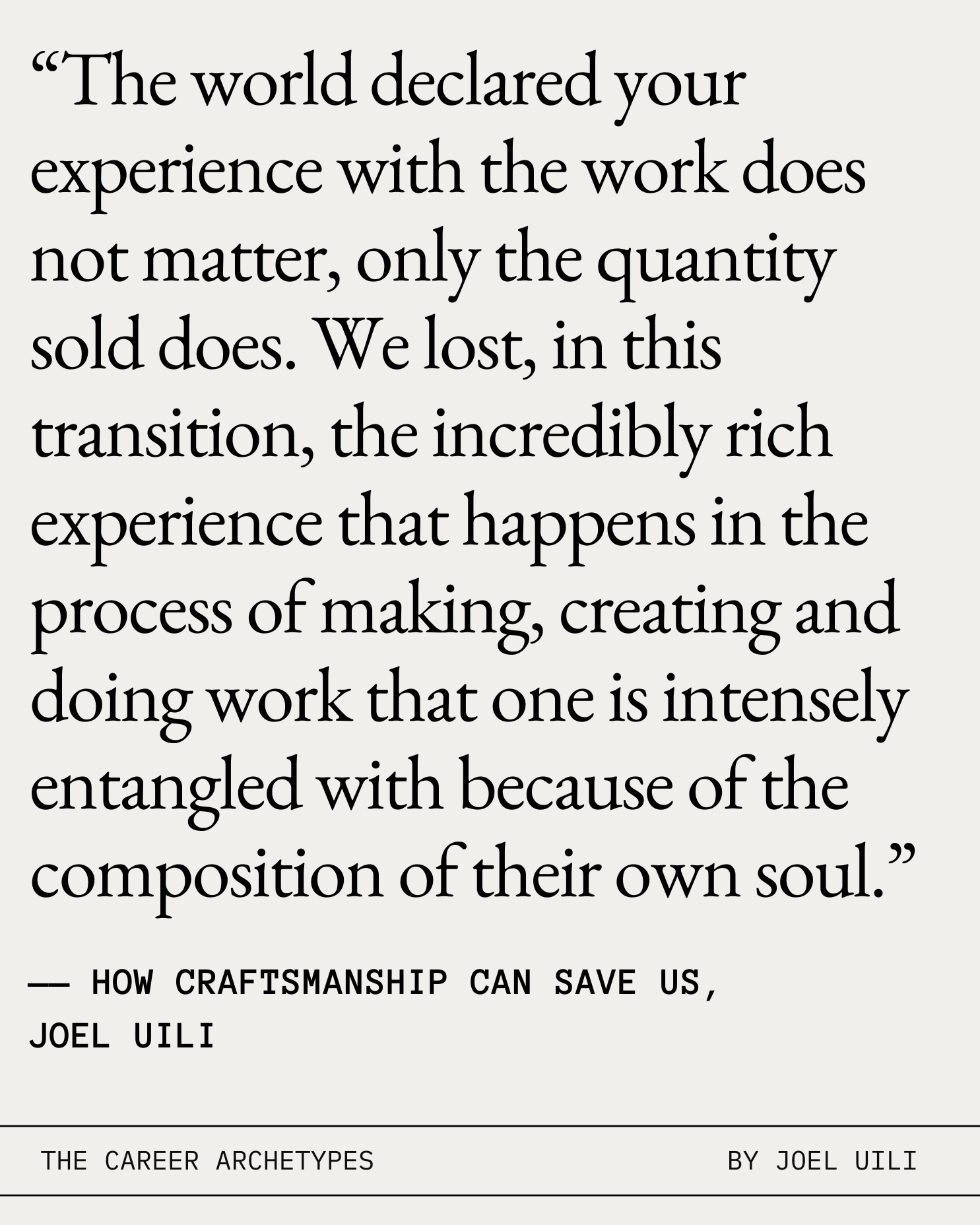
The world declared your experience with the work does not matter, only the quantity sold does. We lost, in this transition, the incredibly rich experience that happens in the process of making, creating and doing work that one is intensely entangled with because of the composition of their own soul. Is it any surprise then, that society is now engaging with work superficially and fixated only on end-results?
We find ourselves the recipients of a Faustian Bargain, whereby humanity traded the experience of creation for things and digital bits. Impoverished by a surface fixation and believing that experience with our work does not matter. It is here that we look to the practice and appreciation of craftsmanship, as it can revive the personal and the sacred in our work.
When an individual suggests using better quality materials to a manager, why are they frequently met with criticism? Told that it costs more, takes too long to source and that they need to be efficient with their time. The human desire to reach higher is squashed. Better is efficiency. Better is cost-cutting. Better is technology doing the job. Better has been defined by someone else.
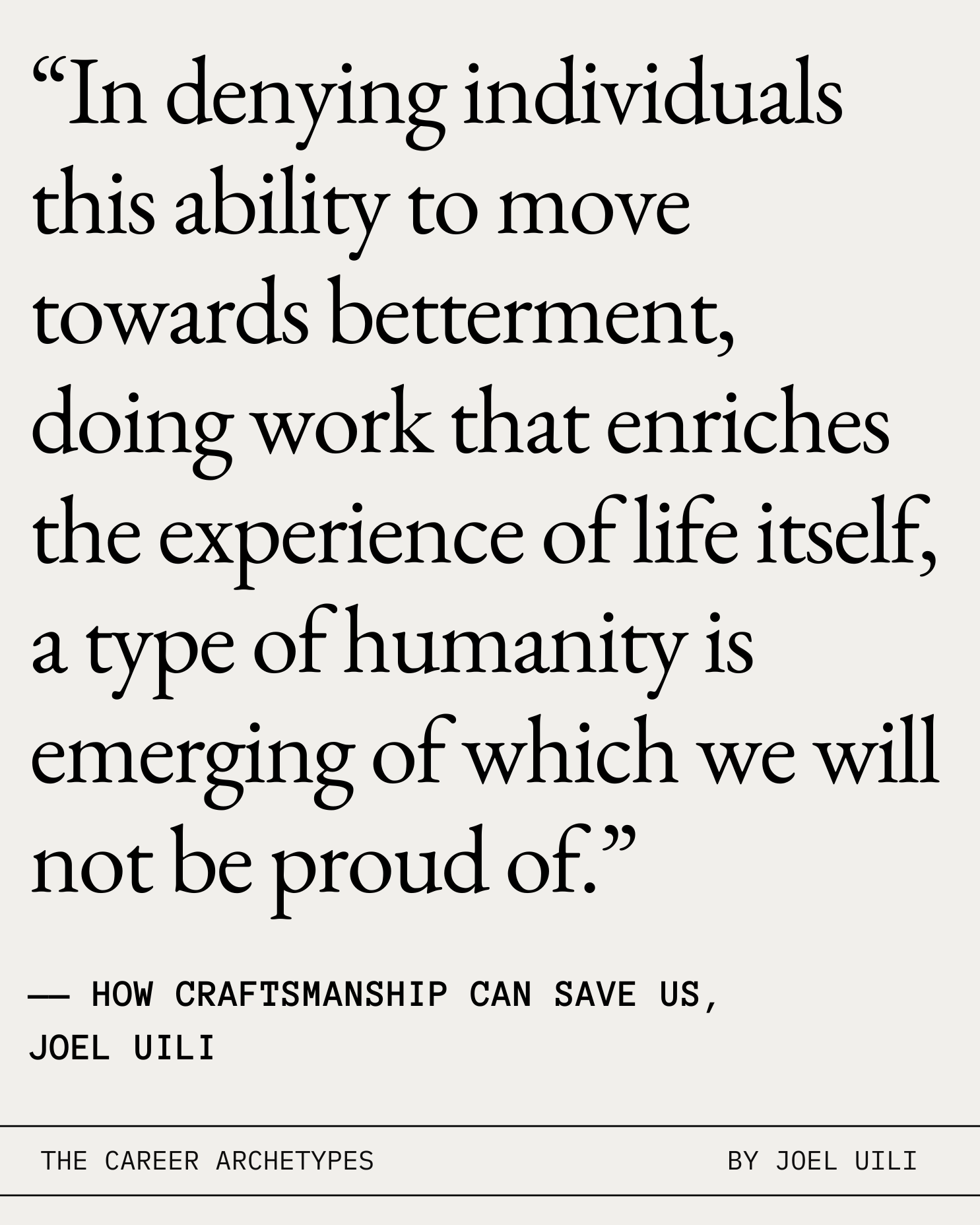
But this definition of better is not better as it lacks the experiential substance of life. As Lloyd Alexander, the young adult fantasy author, said, “Craftsmanship isn’t like water in an earthen pot, to be taken out by the dipperful until it’s empty. No, the more drawn out the more remains.” In denying individuals this ability to move towards betterment, doing work that enriches the experience of life itself, a type of humanity is emerging of which we will not be proud of. One which regularly and consistently lowers itself and calls it, “better” as if to name it as such makes it so.
The widespread lament for the objects that are deteriorating in quality and increasing in price is a symbolic reflection of the inner state of the modern individual’s relationship to their work. Being asked repeatedly to mass produce work that they do not believe in. On the other side of the work, consumers are crying out and telling us that homes are ugly, fashion fabrics are cheap, furniture and appliances do not last a day beyond the warranty and they are right.
But where are the cries for the humans who are making this?
Shaped to lower themselves in exchange for career or business success. My heart breaks at the thought. The maker’s experience with their work is as important as what is created by them and craftsmanship nurtures the souls of all those who practice it. Without craftsmanship modern existence is perverted, forced to look down instead of up.
Modern craftsmanship encourages individuals to raise their heads towards higher possibilities. It looks at the work one is doing and the way we are working, questioning our choices.
Why do you work tired when that will affect the work’s quality?
If those who purchase your work knew how it was created would they still believe you care? Why do you attempt less when you know what better is?
Have you not read Leo Tolstoy’s War and Peace? Viewed the 17th century Fujisan Tea Bowl by Hon’ami Koetsu? Seen a 1967 Ford Mustang coated in Shadow Black G1 paint?
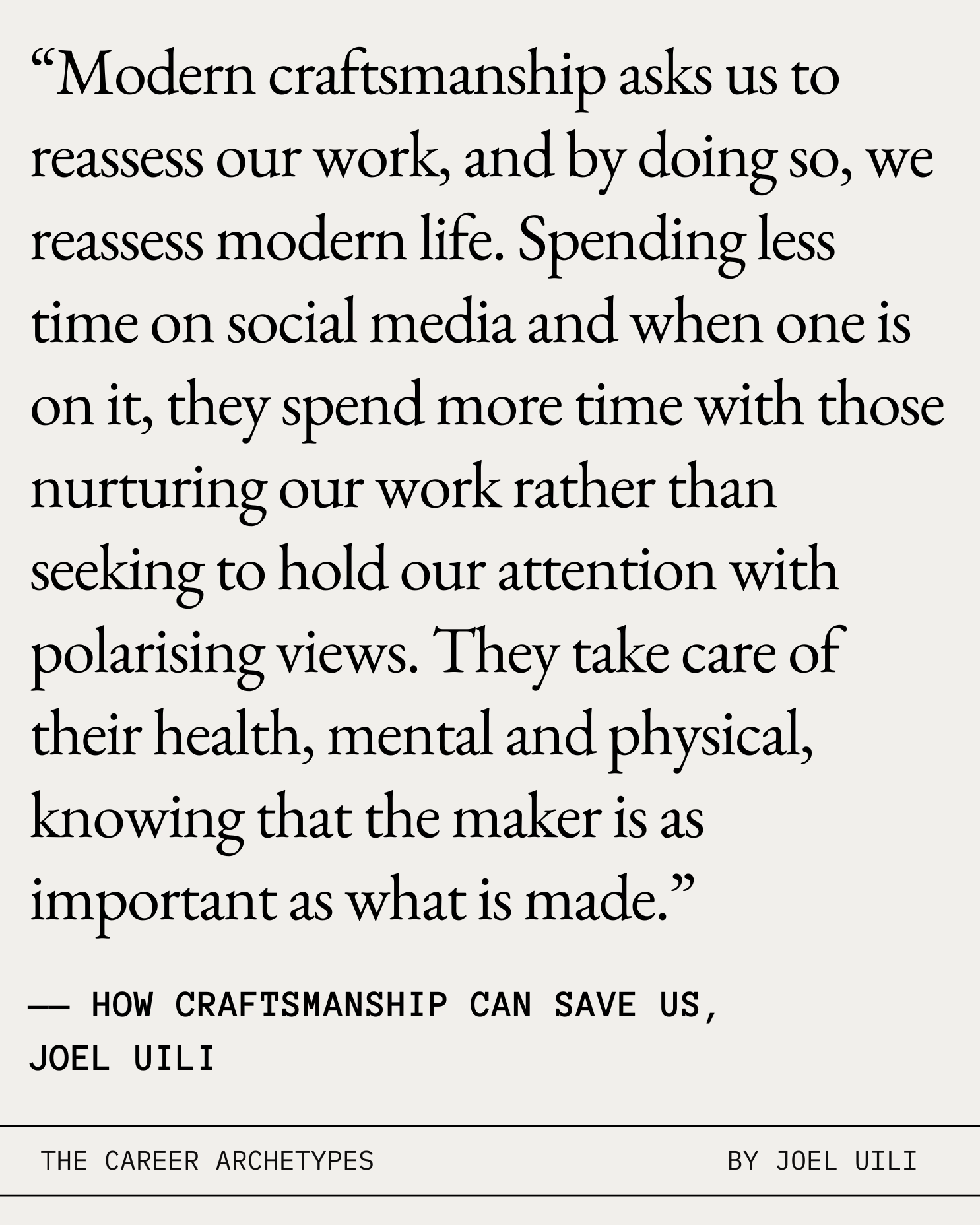
Modern craftsmanship asks us to reassess our work, and by doing so, we reassess modern life. Spending less time on social media and when one is on it, they spend more time with those nurturing our work rather than seeking to hold our attention with polarising views. They take care of their health, mental and physical, knowing that the maker is as important as what is made. That the maker affects what is made.
According to The State of Workplace Burnout 2025 report by Infinite Potential, only 33% of people are satisfied with their job. As for business owners, the University of New Hampshire in 2025 found that 88% of entrepreneurs struggle with their mental health. Here we can view the detachment of the individual from craftsmanship.
No one can be dissatisfied with their job and do their best work.
No one does their best under the weight of mental health issues.
One also challenges themselves with every attempt and to better each true work. Find themselves as an opposing force to low quality mass manufacturing and hyper-consumerism. Knowing that for humanity to believe in craftsmanship again, it begins with not compromising on one’s own work.
Craftsmanship offers us meaningful present moments that are filled with deep pleasure without being purely hedonistic; ready to destroy our future. It also offers future contentment without having to live an ordinary, boring and stoic life.
Because both the process towards and the mastery over one’s craft provides momentary satisfaction, beautifies and excites existence and aids one’s pursuit of their vocation. Exalting them along the way.
If we look at Alexandre Cabanel’s painting entitled, Michelangelo in His Studio Visited by Pope Julius II, we view a renaissance master surrounded by marble statues of his own creation. Engaged with his work, reflecting and thinking about his next decision.
Anyone who practices craftsmanship knows this experience.
The glory of being immersed in the figuring out, the unfolding and the problem solving which generates meaningful work. In this, one loses the boundaries of self and time. An exchange is taking place, between what one is working on and their spirit. Skill acting as a translator and with enough skill, inspiration is properly communicated and poured into a form. Here we are alive. As alive as a human in love. Over time the practice of craftsmanship naturally takes an individual to mastery with its search for quality, its love of skill and belief in the importance of care. This feeling, being fully with ‘it’, and this increasingly rare experience, that of mastering one’s craft, can still be experienced in modern existence.
Deep Dive Study On Modern Craftsmanship:
Modern craftsmanship requires human smudge to be in every work that an individual makes. Without it the human story is missing. It imbues all that it touches with the best of us. This idea, which was laid in point seven of our Craftsmanship Manifesto, reflects how craftsmanship can save us and enrich modern existence.
We are now midway through our eight week deep dive on Modern Craftsmanship here on Substack. With the second half looking at how to apply and navigate craftsmanship in our own practices. For our Path Studies members, know that next week we will be looking at a psychological barrier that emerges as one practices craftsmanship. Which, in overcoming, helps us deepen craftsmanship in our vocations.
If you are a free subscriber, you will not receive this lesson. However if you’d like to, simply upgrade your subscription. By upgrading you’ll also get access to these previous lessons on craftsmanship:


No AI was used throughout the process of creating this article.
Thanks so much for this series on craftmanship, Joel! So so necessary to "hear" this at this point in time <3
Wow I felt this one deeply, thank you